Back to projects

Tomchi Hisob

An entrepreneur's pocket books: cash, partners, expenses, wages

About the project

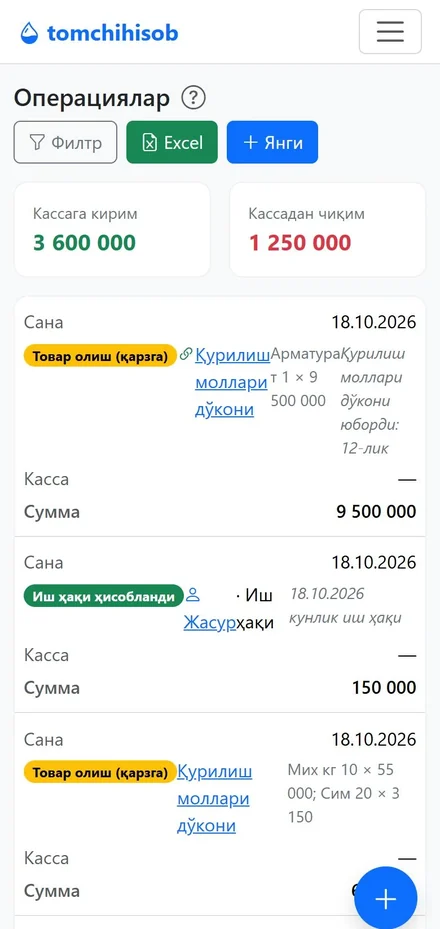
Tomchi Hisob is a deliberately simple bookkeeping app for an entrepreneur. There is no balance sheet, no profit and loss statement and no tax handling: the point is to keep the daily movement of money, and who owes whom how much, exactly right. Everything is written into one journal of operations: cash in and out, expenses, settlement with a partner, wages. Balances and debts are not stored separately — they are computed from that journal, so the figures always agree. The strongest part is settlement between entrepreneurs: you connect a partner by phone number, and when you record an entry a request goes to them; once they confirm, the same entry appears on their side in the opposite direction. A confirmed entry can no longer be changed by either side — a correction is made with a reversing entry. That is what ends the argument about whose notebook is right. At the moment both the new user and the person who invited them receive a 50,000 so‘m bonus, credited to each of their deposits.

Capabilities

  • One journal of operations — cash, expenses, settlement, wages
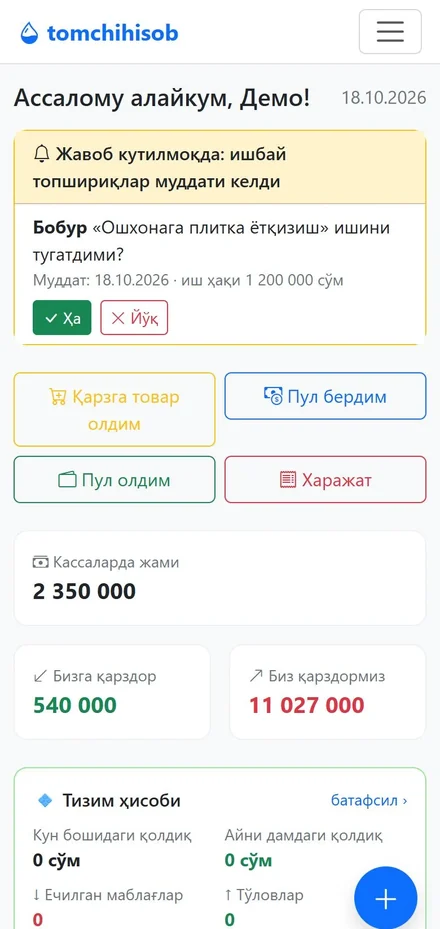
  • Balances and debts are computed from the journal, not kept separately
  • Connect a partner by phone number
  • Two-sided confirmation: afterwards both of you hold the same entry
  • A confirmed entry cannot be edited — only reversed
  • Several cash registers and expense types
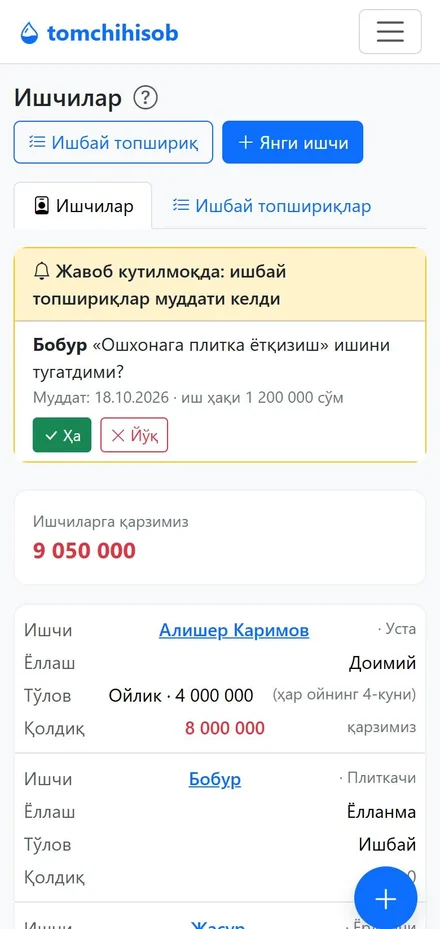
  • Workers: monthly, daily and piecework wages accrue automatically
  • A day marked as not worked is left out of the wages
  • At a piecework deadline the system asks whether the job is finished
  • Reports and a reconciliation statement, with Excel export
  • Telegram bot: balances, quick expense, confirmations, notifications
  • A calculator and a guide inside — a “?” beside every form
  • Referral bonus: 50,000 so‘m each for the new user and whoever invited them

Screens

  • Tomchi Hisob — 1
  • Tomchi Hisob — 2
  • Tomchi Hisob — 3
  • Tomchi Hisob — 4
  • Tomchi Hisob — 5

What changes

Notebook and phone notes

With a paper book
Entries sit in a notebook and in phone notes, and cannot be found when needed.
In the system
Every entry is in one journal, with its date, amount and note.

Settling with a partner

With a paper book
Two notebooks, two figures, and an argument about which is right.
In the system
The partner confirms, and both of you hold exactly the same entry.

Debts

With a paper book
Who owes what is kept in someone's head and on a scrap of paper.
In the system
The partner balance is computed: positive means they owe, negative means you do.

Wages

With a paper book
Counting by hand every month and remembering what is still owed to whom.
In the system
Monthly, daily and piecework all accrue by themselves and stand as a debt to the worker.

Reporting

With a paper book
At the end of the month the figures are gathered by hand.
In the system
Cash, debt, expense and wage reports are ready and export to Excel.

Doing sums

With a paper book
The calculator is a separate app and the result is copied over by hand.
In the system
You can type 10*55000 straight into the amount field and it works it out.

Telegram bot

The Mini App opens through this bot.